
Introduction
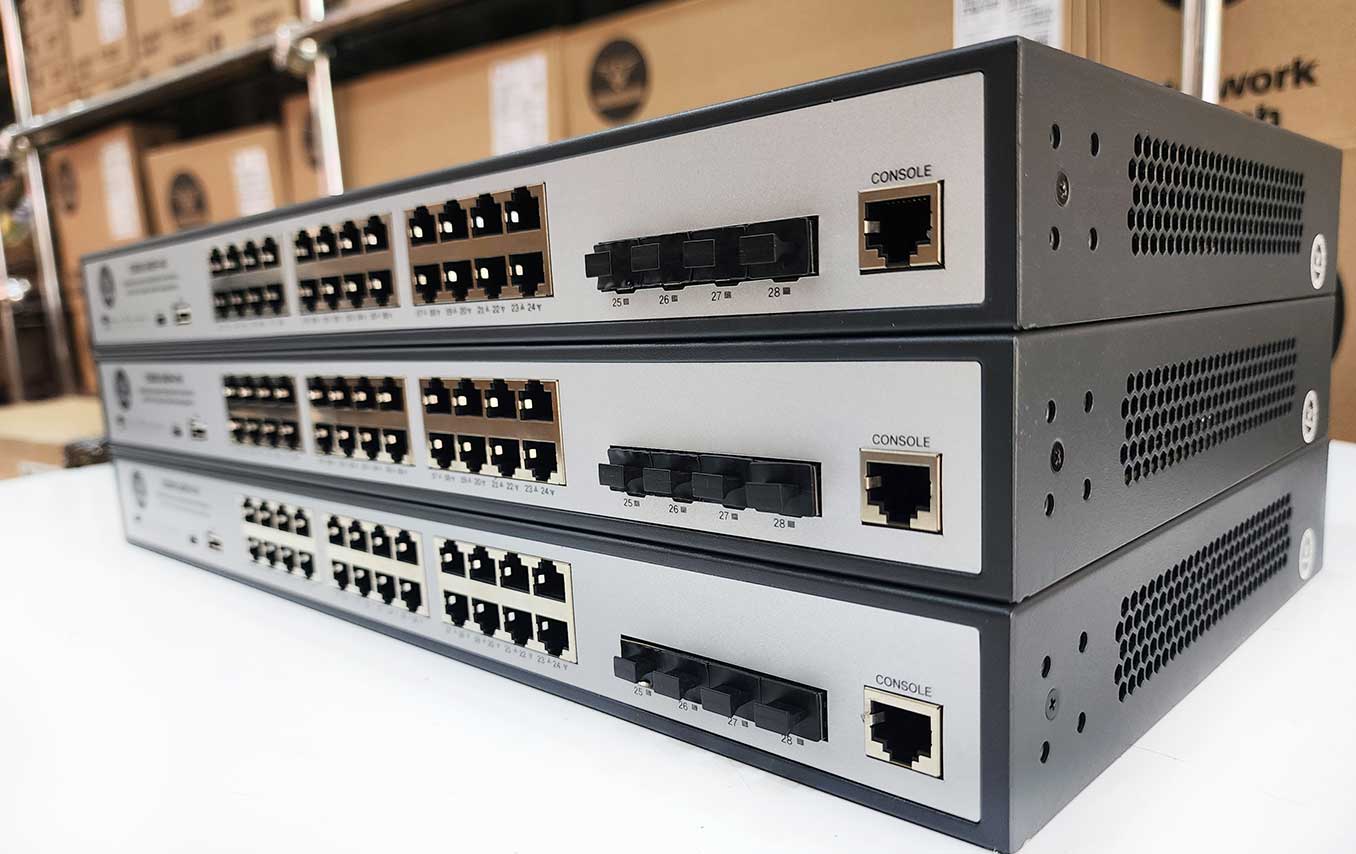
COMMANDO Soldier E3000 Series Switches offers a state of art quality product that can serve on real time high-speed Performance with input power AC as well as DC, covers larger physical distance up to 250 meters with copper cables as compared to other brands best switches. This series is having advance L3 features, which are highly reliable, conformance to international open standards, durable, serviceable, aesthetics, perceived quality, enhanced performance with larger range with copper cables and usability leads to value to money. Easy Management via lots of options like RIP V1/2, OSPF, Advanced Web-based Graphical User Interface (Web GUI), Industry standard Command Line interface (CLI), RADIUS/TACACS+, LLDP/LLDP-MED, Time based PoE/PoE+ Scheduling, DHCP server as well as zero touch provisioning whichever is suitable to our esteem customers.
COMMANDO Soldier E3000 Series switches are L3 Aggregation and Access Series Routing Switches are fully managed L3 having 4, 24 and 48 GE switch ports or 24/48 SFP ports with perpetual PoE/PoE+ IEEE 802.3 af/at (15.4W, 30W) compliant or Non PoE models plus additional fixed 10G or 1G fiber/ 10GE or 1GE copper uplink ports as per requirement with perpetual PoE/PoE+ for no power downtime required for network resiliency and high availability which delivering robust performance and intelligent switching for growing networks. This series switches are easy to deploy, use, manage and designed exclusively for enterprise-class aggregation layer and as edge networks Switches, specially built for Security, IoT, and Cloud networking needs of growing businesses, high-end campus networks for Small-Medium Business (SMB). Designed for operational simplicity to lower total cost of ownership, they enable scalable, secure, and energy-efficient business operations with intelligent and automated services. This intelligent managed routing switches designed for networks requiring High performance, High port density, High uplink bandwidth, Flexibility, Fault Tolerance, and Advanced Software features for maximum Return on Investment (ROI). Switch models are designed for full PoE capability on all ports, power and fan redundancy, Layer 3 feature support static and dynamic routing, these are optimized for today’s surveillance, mobile and IoT needs. Designed for operational simplicity to lower total cost of ownership, they enable scalable, secure, and energy-efficient business operations with intelligent and automated services.
It has high performance fixed uplink with fiber/copper 10G, 1G/10GE, 1GE ports fixed uplink which helps it to meet the requirement of high-end campus LAN, Metro/Enterprise networks. Each switch is capable to deliver 15.4W PoE and 30W PoE+ along with automated power (ON/OFF) scheduling with perpetual IEEE 802.3af compliant PoE (Power over Ethernet), 802.3at compliant PoE+ (Power over Ethernet plus) and having power budget up to 800W. Switches are PoE/PoE+ capable to provide power across all access ports for wireless APs, security cameras, and other IoT devices which are used in surveillance. These switches are powerful and flexible enough for users to deploy PoE/PoE+ standard supplies up to 30W of power per port which is backward compatible with 15.4W PD which makes it ideal for applications using high power wireless access points, PTZ (Pan Tilt Zoom) IP cameras, Surveillance cameras, VoIP telephony systems, kiosks, POS terminals, thin client, 802.11ac and 802.11ax access points, small cells, and connected LED lighting devices over longer distances up to 250 meters. It’s software includes OSPF, RIP, Static route, QoS Traffic classification based on Layer 2, Layer 3, Layer 4, and priority information Actions including ACL, CAR, and re-marking, Queue scheduling modes such as PQ, WFQ and PQ+WRR, Congestion avoidance mechanisms, including WRED and tail drop, Traffic shaping, SNMPv1/v2c/v3, Zero Touch Provisioning (ZTP), 802.1x authentication, RADIUS and TACACS+ authentication for login, DoS, ARP, MAC address attacks, broadcast storms, and heavy-traffic and ICMP attack defenses, Remote Network Monitoring (RMON).
These switches have advanced Security features, and advanced Quality of Service (QoS), ideal for all organizations considering reliable, affordable hardware with well-known CLI and simple Web managed real time interface. Automated PoE/PoE+ scheduling, Scripting capabilities, Layer 3 routing, Automatic MDIX and Auto-negotiation on all ports select the right transmission modes (half or full duplex) as well as data transmission for crossover or straight-through cables dynamically. Moreover, with its innovative energy-efficient technology, can save up to 58% of power consumption, making it an eco-friendly perfect solution for your business network. These switches come with lifetime free software upgrades and patching to enhance features and supports patching, which provides fixes for critical bugs and security vulnerabilities between regular maintenance upgrades. This support allows customers to add new features and upgrades without having to pay a single dollar.
It has a 4K-entry VLAN table which provides VLAN classification according to port-based, protocol-and-port-based, MAC-based, and Flow-based capability. It also supports IVL (Independent VLAN Learning), SVL (Shared VLAN Learning), and IVL/SVL (both Independent and Shared VLAN Learning) for flexible network topology architecture. It provides IEEE802.1ad (Q-in-Q) for double tag insertion and removal function. In additions, VLAN translation function is also supported for Metro Ethernet applications with up to 32K entries L2 MAC table are supported with 2-left 4-way hashing algorithm which can effectively reduce collision ratio. An independent 4K-entry Multicast table is used to support Multicast functions, such as IGMP snooping. The device supports a 4K-entry VLAN/Ingress/Egress Access Control List (ACL). The ACL function supports L2/L3/L4 match fields and performs configurable actions, such as Drop/Permit/Redirect/Mirror /Logging/Policing/Ingress VLAN conversion/Egress VLAN conversion/QoS remarking/VLAN tag status assignment. Per-port ingress/egress bandwidth control and per-queue egress bandwidth control are supported. The device provides three types of packet scheduling, including SP (Strict Priority), WFQ (Weighted Fair Queuing), and WRR (Weighted Round Robin). Each port has 8 physical queues, and each queue provides a leaky bucket to shape the incoming traffic into the average rate behavior. The Broadcast/Multicast/Unknown-Multicast/Unknown-Unicast storm suppression function can inhibit external and internal malicious attacks. The device supports 4-sets of port mirror configurations to mirror ingress and egress traffic. RSPAN, sFlow are also supported for traffic monitoring purposes. For network management purposes, complete MIB counters are supported to provide forwarding statistics in real time. The link aggregation function enhances link redundancy and increases bandwidth linearly. It offers robust QoS to optimize traffic on your Business Network, these switches provide (Port-based/802.1p/DSCP) QoS to keep latency-sensitive video and voice traffic jitter-free moving smoothly. Additionally, port-based, tag-based VLAN, Voice VLANs can improve security and meet more network segmentation requirements. This series switches also have provisioning of QOS, Static and dynamic routing for IPV6 clients.
Simplified Configuration and Management
Zero-Touch Provisioning (ZTP) simplifies installation of the switch.
Easy to manage via Console/web-Based Management (WEB GUI)/Telnet/SSH/ HTTPS.
Remote Manageability
Remote management is the process that allows the administrators to take full control of all operations using a remote. This remote management via WEB GUI /Telnet/ SSH/ HTTPS will reduce time and money spent on management and maintenance and physical presence of Network Engineer.
Management by CLI- Console, Telnet (RFC854) up to 3 sessions
Management by WEB GUI- HTTP, HTTPS for management Based on Remote Configuration and maintenance Using Telnet.
In this CLI guide we will understand Management by Command Line Interface (CLI) through console port, telnet management mode.
Management Access Modes
Accessing the Switch via console port
How to Login COMMANDO Series E3000 via console port?
The console interface is used by connecting the Switch to a VT100–compatible terminal or a computer running an ordinary terminal emulator program (e.g., the Hyper Terminal program included with the Windows operating system) using an RS–232C serial cable. Your terminal parameters will need to be set to:
- VT–100 compatible
- 115200 baud
- 8 data bits
- No parity
- One stop bit
- No flow control
Users may also access the same functions over a Telnet interface. Once you have set an IP address for your Switch, you can use a Telnet program (in VT–100 compatible terminal mode) to access and control the Switch. All the screens are identical, whether accessed from the console port or from a Telnet interface.
Step 1: Connect the Switch console port with PC/Laptop via console cable.


Fig-1. Connection of console port with PC/Laptop via console cable.
Step 2:The communication parameters configuration of the PuTTY Terminal with console is shown below Baud rate (Speed):115200

Fig-2. PuTTY configuration in PC for console port access
Step 3: Click on “Open”. You will get following window.
With the console port properly connected to a management computer, the following screen should be visible.

Fig-3. COMMANDO Series E3000 Switch CLI access via console port
How to Login COMMANDO Series E3000 WEB GUI and Enable Telnet?
Before Accessing Command Line Interface via telnet you have to login to WEB GUI of COMMANDO E3000 Switch. Connect one Ethernet port to your system with RJ45 LAN cable.

Fig-4. COMMANDO Series E3000 Switch port connected with PC via RJ45 LAN cable.
In PC following LAN setting required.
- Open Network and sharing center
- Click change Adapter settings
- Double click on Local Area Connection.
- Click Properties.
- Double click on Internet Protocol Version 4(TCP/IPv4) option and set default IP as shown below.
IP Address: 192.168.0.(2-254)
Subnet Mask: 255.255.255.0
Default Gateway: 192.168.0.1

Fig-5. Local Area Connection properties for Web Interface
Now Open any web browser type http://192.168.0.1 and hit “Enter” following window will appear.
Use following login details to enter in WEB GUI mode,
Username: admin
Password: ********
(Note: Password is mentioned on backside of device)
Enter the login button. COMMANDO E3000 series switch starting Page appears.

Fig-6. COMMANDO E3000 Switch WEB GUI Administrator Login Page

Fig-7. COMMANDO E3000 Switch WEB GUI starting Page
Following steps are required to access CLI via telnet lines.
Management>>Management Access>>Management Service
Click on Management
Click on Management Access
Click on Management Services
Telnet Click on 
“Apply” and “Save” the configuration.
This is required stage before accessing COMMANDO E3000 Switch Command Line Interface (CLI) to enable “Telnet”. By default, “Telnet” service is disabled by default, so you must enable it manually.
Management >>Management Access>>Management Service is very important page to enable and disable Telnet, SSH, HTTP, HTTPS, SNMP and Set Session Timeout (By default 10min), Password Retry Count (By default 3), Silent Time (To block all further login attempts until the timer expires by default is 0 second).

Fig-8. COMMANDO E3000 Switch Management Access service.
Web browse based graphical user interface (Web GUI)
COMMANDO E3000 Series SoldierOS had a web browser based graphical user interface (Web GUI). This is inbuilt in each COMMANDO E3000 series switches. You can use either the CLI via Console/Telnet or WEB GUI for managing E3000 Series Switches. COMMANDO Networks recommend that you use this WEB GUI which can configure almost everything as you needed in simple and user-friendly manner. This WEB GUI is a state of art having world class features with which you can configure basic, advance, and special feature very easily. After setting the Proper PC LAN parameter given above and in Web browser giving IP address 192.168.0.1 you will get the login page.

Fig 9. Username and Password page of E3000 Series Switches

Fig 10. Default Login page of E3000 Series Switches
Note: With E3000 Web based Graphical User Interface (Web GUI)
You can change default IP 192.168.0.1 to any desired IP address.
You can change Factory set username: admin and password: *******.
Factory set default Password is written on the Backside of device.
After you login the web page successfully, you will see the System information page which provides you real time status of Switch. This page shows very important System information of this E3000 device which can help in troubleshooting network issues. The upper frame is the front panel frame, which shows the connection situation of each port. If a port is connected and link is up and working properly then the corresponding port on the front panel will be green.

Fig 11. System Information page of E3000 Series Switches
Management via Telnet configuration in CLI
To Configure the switch with Telnet, users should type the CLI command telnet-server enable in the global mode as below:
Step 1: Enable telnet-server
Switch>enable
Switch#configure terminal
Switch(config)# telnet-server enable
Step 2: Run Telnet Client program (PuTTY)
The communication parameters configuration of the PuTTY Terminal with TELNET is shown below:
IP Address: 192.168.0.1
Port: 23

Fig-12. PuTTY configuration in PC for Telnet access
Step 3: Click on “Open”. You will get following window.
Username: admin
Password: ********
(Note: Password is mentioned on backside of device)

Fig-13. COMMANDO Series E3000 Switch CLI access via telnet