
Introduction
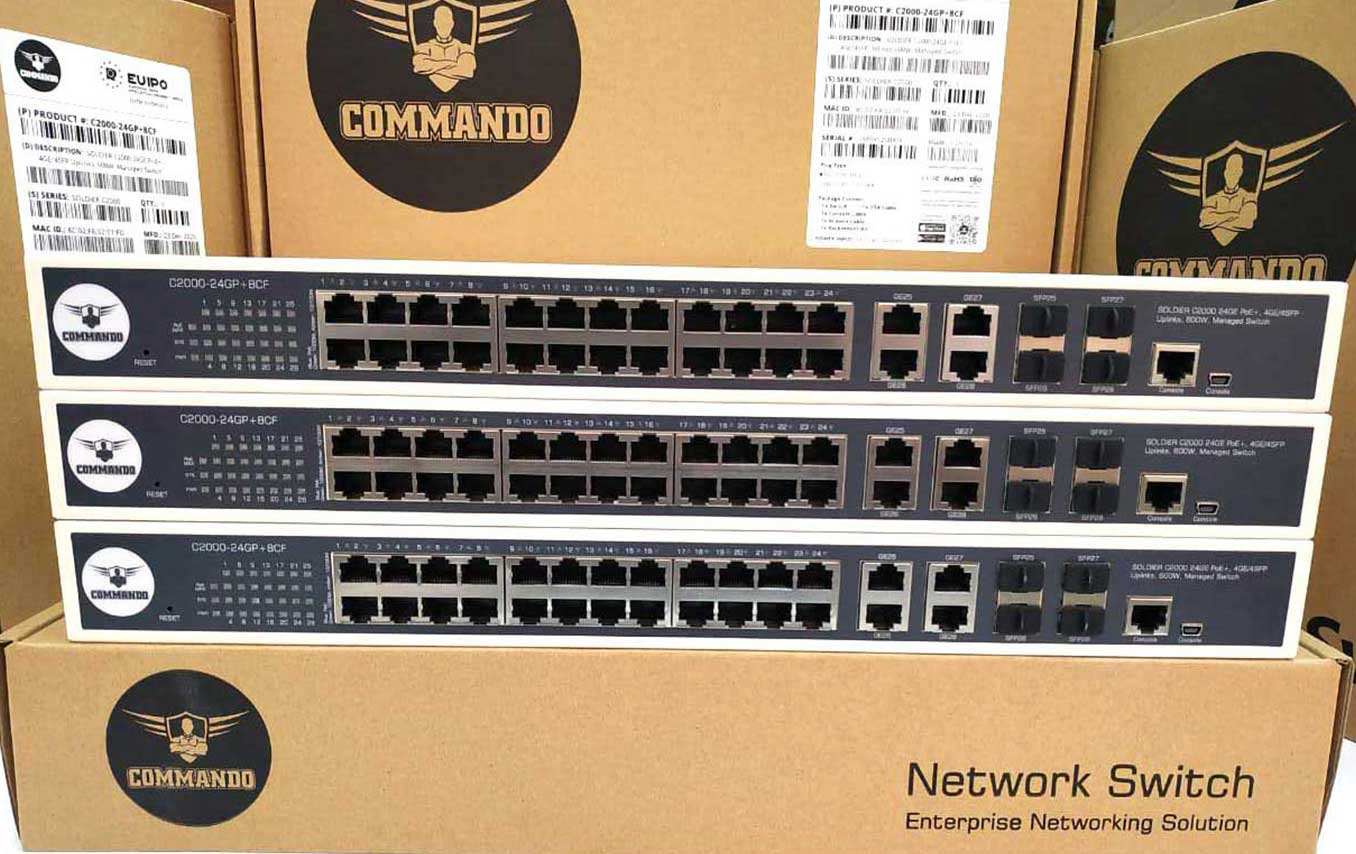
COMMANDO Soldier C2000 Series Switches offers a state of art quality product that can serve on real time high-speed Performance with dual input power AC as well as DC, Covers larger physical distance upto 250 meters with copper cables as compared to other brands best switches. This series is having advance L2+ and basic L3 features, which are highly reliable, conformance to international open standards , durable, serviceable, aesthetics, perceived quality, enhanced performance with larger range with copper cables and usability leads to value to money. Easy Management via lots of options like Web-based Graphical User Interface (WEBUI) , Command Line interface (CLI) , RADIUS/TACACS+, LLDP/LLDP-MED, Time based PoE/PoE+/PoE++ Scheduling, DHCP server as well as zero touch provisioning Whichever is suitable to our esteem customers.
COMMANDO Soldier C2000 Series Switches Series are fixed-configuration, with flexible uplinks Gigabit Ethernet switches that provide enterprise-class access for campus and branch applications. Designed for the digital workplace, these are optimized for today’s mobile and IoT needs. These switches are powerful and flexible enough for users to deploy PoE/PoE+/PoE++ standard supplies up to 90W of power per port ideal for applications using high power wireless access points, PTZ (Pan Tilt Zoom) IP cameras,Surveillance cameras, VoIP telephony systems, kiosks, POS terminals, thin client, 802.11ac and 802.11ax access points, small cells, and connected LED lighting devices over longer distances up to 250 meters. The 90W PoE++; IEEE 802.3bt technology drives high-power infrastructure for smart building systems, safe cities, thin clients, and a lot more. Facility managers and building owners can adopt the standard to future-proof their all PoE/PoE+/PoE++ networks requirements. The outcome for them is lower installation and wiring costs. COMMANDO Soldier C2000 Series provide easy device rack and wall mounting, on boarding, configuration, monitoring, and troubleshooting. These fully managed switches can provide advanced L2+ and basic Layer 3 features as well as supports IEEE 802.3af-compliant PoE (Power over Ethernet), 802.3at-compliant PoE+ (Power over Ethernet plus) and IEEE802.3bt type-4 (Power over Ethernet plus plus). Each switchport is capable to deliver 15.4 W PoE, 30 W PoE+ and 90W PoE++ power on all ports along with automated power (ON/OFF) scheduling. All Switches are PoE/PoE+/PoE++ capable to provide power across all access ports for wireless APs, security cameras, and other IoT devices. Designed for operational simplicity to lower total cost of ownership, they enable scalable, secure, and energy-efficient business operations with intelligent and automated services.
COMMANDO Soldier C2000 Series Switches RJ-45 auto sensing/auto PoE/PoE+/PoE++ 10/100/1000 ports with auto MDIX capabilities which also removes speed and duplex mismatches automatically as well as covers larger physical distance with copper pairs compared to other brands best switches . This series switches supports 8K MAC address tables , 4.1MB Packet Buffer memory , 10K bytes Jumbo Frames, Ipv4/IPv6 with 1024 static routing entries,s( MAC/IP/Port based), Port aggregation upto 8 ports, VLAN, Voice VLAN, GVRP, DHCP Server,DHCP Client, DHCP Snooping, DHCP Snooping option82, DHCP Relay, 802.1X authentication, centralized MAC authentication, Guest VLAN, RADIUS authentication, SSH 2.0, Port isolation, Port security, MAC address learning limit, IP Source guard, Dynamic ARP inspection, preventing man-in-the-middle attacks and ARP DoS attacks, IP/Port/MAC binding. COMMANDO Soldier C2000 Series Switches Management is made easy via a web-based Graphical User Interface (WEBUI/ ) or industry-standard Command Line Interface (CLI), with administration traffic protected via SSL or SSH encryption. SNMP (v1/v2c/v3) and RMON support enables the switch to be polled for valuable status information and allows it to send traps when abnormal events occur.
COMMANDO Soldier C2000 Series Switches with easy installation, configuration, monitoring, and troubleshooting and greatly reduces initial installation, configurationas well as administration costs. This series has improved HTTP base firmware upgrade as well as CLI based Updates which are freely available to all users without any cost or license fee for all times . These series switches supports Flexible service control with various ACLs to flexibly control ports. It also supports port-based VLAN assignment, MAC address-based VLAN assignment, protocol-based VLAN assignment, and network segment-based VLAN assignment. These secure and flexible VLAN assignment modes are used in networks where users move frequently. It also supports GARP VLAN Registration Protocol (GVRP), which dynamically distributes, registers, and propagates VLAN attributes to ensure correct VLAN configuration and reduce network administrator workloads. This series switches supports SSH v1/v2/v3, RMON, and port-based traffic statistics.
COMMANDO Soldier C2000 Series Switches are the ideal solution for the most advanced small and medium organizations looking for the best combination of features, performance, and value. These switches are purposely designed for converged networks where voice, video, data are all carried on a single network platform. This series comes with fan/fanless switches models along with Small form-factor, fanless as well fan design for silent operation. Perfect for noise sensitive environments. Fan based Switches have Temperature- and load-based fan-speed control combines accurate monitoring with minimized system acoustic noise. The Fan based switches also feature built-in smart fans that monitor and detect temperature changes, adjusting the fan speed for maximum efficiency. At lower temperatures, the fans run at a lower speed, reducing both the power consumption and noise output of the switch.These cost effective switches, with a reasonable PoE/PoE+ power budget up to 800W along with PoE/PoE+/PoE++ configurable scheduler to automated Power ON/OFF connected PoE/PoE+/PoE++ devices as per scheduled timing.
The document is a user guide for COMMANDO Web demonstration web pages on C2000.The C2000 acts as a web server to accept http connection request and replies web pages so that user can get configuration or change configuration to C2000 by web access.
The COMMANDO SoldierOS IP Base switches Management is made easy via a web-based Graphical User Interface (WEBUI) access via HTTP/HTTPS or industry-standard Command Line Interface (CLI) via Console/Telnet with administration traffic protected via , SNMP v1/v2C/v3, SSH v1/v2, RMON v1/v2 which enables the switch to be polled for valuable status information and allows it to send traps when abnormal events occur.
Simplified Configuration and Management
Zero-Touch Provisioning (ZTP) simplifies installation of the switch.
Easy to manage via Console/web-Based Management (WEBUI)/Telnet/SSH/ HTTPS.
Remote Manageability
Remote management is the process that allows the administrators to take full control of all operations using a remote. This remote management via WEBUI / Telnet/ SSH/ HTTPS will reduce time and money spent on management and maintenance and physical presence of Network Engineer.
Management by CLI- Console, Telnet (RFC854) up to 3 sessions
Management by WebUI- HTTP, HTTPS for management Based on Remote Configuration and maintenance Using Telnet.
In this CLI guide we will understand Management by Command Line Interface(CLI) through console port, telnet management mode.
Accessing the Switch via console port
How to Login COMMANDO Series C2000 via console port?
The console interface is used by connecting the Switch to a VT100–compatible terminal or a computer running an ordinary terminal emulator program (e.g., the HyperTerminal program included with the Windows operating system) using an RS–232C serial cable. Your terminal parameters will need to be set to:
• VT–100 compatible
• 115200 baud
• 8 data bits
• No parity
• One stop bit
• No flow control
Users may also access the same functions over a Telnet interface. Once you have set an IP address for your Switch, you can use a Telnet program (in VT–100 compatible terminal mode) to access and control the Switch. All of the screens are identical, whether accessed from the console port or from a Telnet interface.
Step 1: Connect the Switch console port with PC/Laptop via console cable.
Fig-1. Connection of console port with PC/Laptop via console cable.
Step 2: The communication parameters configuration of the Putty Terminal with console is shown below Baud rate (Speed):115200
Fig-2. Putty configuration in PC for console port access
Step 3: Click on “Open”. You will get following window.
With the console port properly connected to a management computer, the following screen should be visible.
Fig-3. COMMANDO Series C2000 Switch CLI access via console port
How to Login COMMANDO Series C2000 WEBUI and Enable Telnet?
Before Accessing Command Line Interface via telnet you have to login to WEBUI of COMMANDO C2000 Switch. Connect one Ethernet port to your system with RJ45 LAN cable.
Fig-4. COMMANDO Series C2000 Switch port connected with PC via RJ45 LAN cable.
In PC following LAN setting required.
- Open Network and sharing center.
- Click change Adapter settings.
- Double click on Local Area Connection.
- Click Properties.
- Double click on Internet Protocol Version 4(TCP/IPv4) option and set default IP as shown below.
IP Address: : 192.168.0.(2-254)
Subnet Mask: 255.255.255.0
Default Gateway: 192.168.0.1
Fig-5. Local Area Connection properties for Web Interface
Now Open any web browser type http://192.168.0.1 and hit “Enter” following window will appear.
Use following login details to enter in WEBUI mode,
Username: admin
Password: ********
(Note:- Password is mentioned on backside of device)
Enter the login button. COMMANDO C2000 series switch starting Page appears.
Fig-6. COMMANDO C2000 Switch WEBUI Administrator Login Page
Fig-7. COMMANDO C2000 Switch WEBUI starting Page
Following steps are required to access CLI via telnet lines.
Management>>Management Access>>Management Service
Click on Management
Click on Management Access
Click on Management Services
Telnet Click on
“Apply” and “Save” the configuration.
This is required stage before accessing COMMANDO C2000 Switch Command Line Interface (CLI) to enable “Telnet”. By default “Telnet” service is disabled by default so you have to enable it manually.
Management>>Management Access>>Management Service is very important page to enable and disable Telnet ,SSH ,HTTP, HTTPS ,SNMP and Set Session Timeout (By default 10min), Password Retry Count (By default 3) , Silent Time (To block all further login attempts until the timer expires By default is 0 second) .
Fig-8. COMMANDO C2000 Switch Management Access service.
Users access CLI through TELNET
Following are the steps to access CLI via telnet.
Step 1 : Connect the LAN port of PC/Laptop with any Ethernet port of the switch by LAN cable.
Step 2 : The communication parameters configuration of the Putty Terminal with TELNET is shown below:
IP Address: 192.168.0.1
Port: 23
Fig-9. Putty configuration in PC for Telnet access
Step 3: Click on “Open”. You will get following window.
Username: admin
Password: ********
(Note:- Password is mentioned on backside of device)
Fig-10. COMMANDO Series C2000 Switch CLI access via telnet
1.1 Web browse based graphical user interface (WEBUI) Introduction
COMMANDO C2000 Series SoliderOS had a web browser based graphical user interface (WEBUI). This is inbuilt in each COMMANDO C2000 series switches. You can use either the CLI via Console/Telnet or WEBUI for manageing C2000 Series Switches. COMMANDO Networks recommend that you use this WEBUI which can configure almost everything as you needed in simple and user friendly manner. This WEBUI is a state of art having world class features with which you can configure basic, advance and special feature very easily. After setting the Proper PC LAN parmeter given above and in Web browser giving IP address 192.168.0.1 you will get the login page.
Fig 1.1 Default Login page of C2000 Series Switches
Fig 1.2 Username and Password page of C2000 Series Switches
Note:- With C2000 Web based Graphical User Interface ( WEBUI)
1. You can change default IP 192.168.0.1 to any desired IP address.
2. You can change Factory set username--> admin and password-->*******.
3. Factory set default Password is written on the Backside of device.
After you login the web page successfully, you will see the System information page which provides you real time status of Switch. This page shows very important System information of this C2000 device which can help in troubleshooting network issues. The upper frame is the front panel frame, which shows the connection situation of each port. If a port is connected and link is up and working properly then the corresponding port on the front panel will be green.
Fig 1.3 System Information page of C2000 Series Switches
1.2 Main Menu Description in WEBUI
The left hand panel shows the configuration the configuration web pages tabs. All configuration web pages are hidden by the group head label. To expand the group head label, click the down arrow sign on the left side of main WEB page . Then this downarrow key can expand group head label to get specific Web pages for Switch to configure as per requirement of users.
In C2000 Series Switches SoliderOS comes with PoE as Well as Non PoE models. COMMAMDO SoilderOS has 15 Group heads for C2000 PoE based switches and 14 Group heads for Non PoE switches. Lots of functions and protocols can be easily configured by WEBUI and very handy and easy to trobleshoot any networking issue.
Fig 1.4 WEB Pages for C2000 Series Switches.
Quick Start Device Configuration
To simplify C2000 Series device configuration through quick navigation, the Getting Started page provides links to the most commonly used pages.
Table 1.1 C2000 Series Switches SoliderOS Web Software Frameworks.
| Group head lable | Corresponding Web pages |
| Status | System Information System Time Logging Message Port Statistics Error Disabled Bandwidth Utilization Link Aggregation MAC Address Table |
| Network | IP Address DNS Hosts |
| Port | Port Setting Error Disabled Link Aggregation Group Port Setting LACP EEE Jumbo Frame Port Security Protected Port Storm Control Mirroring |
| POE Setting | POE Port Setting POE Port Timer Setting Note:-1. Only Avaliable in PoE/PoE+/PoE++ Switches. 2. Intellligent PoE/PoE+/PoE++ Schedular is special feature of COMMANDO C2000 Series Switches. |
| VLAN | VLAN Create VLAN VLAN Configuration Membership Port Setting Voice VLAN Property Voice OUI Protocol VLAN Protocol Group Group Binding MAC VLAN MAC Group Group Binding Surveillance VLAN Property Surveillance OUI GVRP Property Membership Statistics |
| MAC Address Table | Dynamic Address Static Address Filtering Address Port Security Address |
| Spanning Tree | Property Port Setting MST Instance MST Port Setting Statistics |
| Discovery | LLDP Property Port Setting MED Network Policy MED Port Setting Packet View Local Information Neighbor Statistics |
| DHCP | Property IP Pool Setting VLAN IF Address Group Setting Client List Client Static Binding Table |
| Multicast | General Property Group Address Router Port Forward All Throttling Filtering Profile Filtering Binding IGMP Snooping Property Querier Statistics MLD Snooping Property Statistics MVR Property Port Setting Group Address |
| Routing | IPv4 Management and Interfaces IPv4 Interface IPv4 Routes ARP IPv6 Management and Interfaces IPv6 Interface IPv6 Addresses IPv6 Routes IPv6 Neighbors |
| Security | RADIUS TACACS+ AAA Method List Login Authentication Authentication Manager Property Port Setting MAC-Based Local Account WEB-Based Local Account Sessions DoS Property Port Setting Dynamic ARP Inspection Property Statistics DHCP Snooping Property Statistics Option82 Property Option82 Circuit ID IP Source Guard Port Setting IMPV Binding Save Database |
| ACL | MAC ACL MAC ACE IPv4 ACL IPv4 ACE IPv6 ACL IPv6 ACE ACL Binding |
| QOS | General Property Queue Scheduling CoS Mapping DSCP Mapping IP Precedence Mapping Rate Limit Ingress / Egress Port Egress Queue |
| Diagnostics | Logging Property Remote Server Mirroring Ping Traceroute Copper Test Fiber Module UDLD Property Neighbor |
| Management | User Account Management Access Management VLAN Management Service Management ACL Management ACE Firmware Upgrade Active Image Configuration Upgrade Save Configuration SNMP View Group Community User Engine ID Trap Event Notification RMON Statistics History Event Alarm Restore Factory Default |
1.3 Save, Logout, Reboot, Debug Buttons
1.3.1 Save
By clicking Save button will copy running-config to startup-config to save the current running configuration to the startup configuration file in Switch Memory. This means that if power failure or device OFF/ON configuration will not be lost and remained as per saved configuration.
Fig 1.3.1 Save button
Fig 1.3.2 Applying Save button
1.3.2 Logout
Loging out means to end access to a COMMANDO Switch on a WEBUI. Logging out informs the COMMANDO Switch that the current user wishes to end the login session.
Fig 1.3.3 Logout button on WEBUI
Fig 1.3.4 Applying Logout button on WEBUI
1.3.3 Reboot
Reboot means boot again. COMMANDO Switch is force by this command to power OFF and immediately Power-On. This command forcefully restarting the Switch again.
Fig 1.3.5 Reboot button on WEBUI
Fig 1.3.6 Applying Reboot button on WEBUI
1.3.4 Debug
Debug is used to find and resolve bugs or defects. Debugging is the process of troubleshooting for detecting and removing of existing and potential issue in network.
Fig 1.3.6 Debug message button on WEBUI
Fig 1.3.7 View Debug message on WEBUI
Status
Group Header:- Status
After clicking Status down arrow keys four corresponding web pages tabs are opened.
System Information:--> This section describes how to view system information and configure various options on the device. It covers also This web page shows the Exact running status of device along with LED Indication like Power, System, connection and activity for all ports, UP/Down status of all ports as well as configuration for devices such as System Information, Model, System Name,System Location, System Contact, Serial Number, MAC Address, IPv4 Address, IPv6 Address, System OID, System Uptime, Current Time, Loader Version, Loader Date, Firmware Version, Firmware Date. This page also gives enabled status device management lines like Telnet, SSH , HTTP, HTTPS, SNMP.
System Time :-->System time options for configuring the system time, time zone, and Daylight Savings Time (DST).
Loggin Message:--> You can enable or disable logging on the Log Settings page, and select whether to aggregate log messages.
Port :--> You can view port statistics and reset the port counters.
Link Aggregation:--> Enable/disable the Link Aggregation Control (LAG) protocol, and configure the potential member ports to the desired LAGs by using the LAG Management page. By default, all LAGs are empty.
MAC Address Table:--> There are two types of MAC addresses—static and dynamic. Depending on their type, MAC addresses are either stored in the Static Address table or in the Dynamic Address table, along with VLAN and port information. Static addresses are configured by the user, and therefore, they do not expire.These pages describe how to add MAC addresses to the system. It covers Configuring Static MAC Addresses, Managing Dynamic MAC Addresses.
2.1 System Information
This is the main display page of C2000 SoilderOS. This web page shows the Exact running status of device along with LED Indication like Power, System, connection and activity for all ports, UP/Down status of all ports as well as configuration for devices such as System Information, Model, System Name,System Location, System Contact, Serial Number, MAC Address, IPv4 Address, IPv6 Address, System OID, System Uptime, Current Time, Loader Version, Loader Date, Firmware Version, Firmware Date. This page also gives enabled status device management lines like Telnet, SSH , HTTP, HTTPS, SNMP.
Fig 2.1 System information Web page
2.1.1 Changing the System Name, Location and Contact
Following are the steps to changed the Default System Name, Location and Contact.
Status>>System Information>>Edit button
Fig 2.1.1 Changing the System Name,System Location and System Contact
After clicking Status>>System Information>>Edit button, Modify the System Name, System Location and System Contact as per users requirements.
Fig 2.1.2 Changing System Name, System Location and System Contact
After changing System Name, System Location and System Contact click on Apply button. Then you can see the changed System Name, System Location and System Contact.
Fig 2.1.3 Viewing Changed System Name, System Location and System Contact
2.2 System Time
Synchronized system clocks is critical because every aspect of managing, securing, planning, and debugging a network involves determining when events occur. Without synchronized clocks, accurately correlating log files between devices when tracking security breaches or network usage is impossible. Synchronized time also reduces confusion in shared file systems, as it is important for the modification times to be consistent, regardless of the machine on which the file systems reside. For these reasons, it is important that the time configured on all of the devices on
the network is accurate.
System time can be set manually by the user, dynamically from an SNTP server, or
synchronized from the PC running the WEBUI. If an SNTP server is chosen, the manual time settings are overwritten when communications with the server are
established.
As part of the boot process, the device always configures the time, time zone, and
DST. These parameters are obtained from the PC running the WEBUI, SNTP, values set manually, or if all else fails, from the factory defaults.
The following methods are available for setting the system time on the Switches
Manual—You must manually sets the time.
From PC—Time can be received from the PC by using browser information.
This method of setting time from PC works with both HTTP and HTTPS connections.
SNTP—Time can be received from SNTP time servers. SNTP ensures
accurate network time synchronization of the device up to the millisecond by
using an SNTP server for the clock source.
This page allow user to set time source, static time, time zone and daylight saving
settings. Time zone and daylight saving takes effect both static time or time from
SNTP server.
To display System Time page, click Status>> System Time
Fig 2.2.1 Default System Time configuration page
Time Zone and Daylight Savings Time (DST)
A time zone is one of the areas into which the world is divided where the time is calculated as being a particular number of hours behind or ahead of GMT.The main purpose of Daylight Saving Time (called "Summer Time" in many places in the world) is to make better use of daylight. We change our clocks during the summer months to move an hour of daylight from the morning to the evening.
Fig 2.4.2 Timezone configuration page
Fig 2.4.3 Daylight saving time configuration page
From Computer
This is the best way to configure the time setting in switch. C2000 Series Switches will take and sync with loggin PC time automatically . This is a recommended setting to have proper time setting in switch. Just select proper time zone as per country or requirement.
To configure and view this recommended setting click on Status>> System Time and use source From Computer.
Fig 2.4.4 Time configuration from connected computer page
Fig 2.4.5 Time configuration from connected computer page
SNTP
The simple network time protocol (SNTP) is a time synchronization protocol of the TCP/IP protocol family. It is based on the connectionless user datagram protocol (UDP) and can be used on all supporting devices to synchronize system time in IP networks (IPv4 and IPv6). Time can be received from SNTP time servers. SNTP ensures accurate network time synchronization of the device up to the millisecond by using an SNTP server for the clock source. You can also set local or public time server IP or Hostname if time server is locally available.
Fig 2.4.6 SNTP configuration page
After changing Time you can verify the changed time from system information page.
Fig 2.4.5 System Information page displaying current time.
2.3 Logging Message
This page shows the log messages Logging Message Table of RAM by System Log feature, which enables the device to generate multiple independent logs. Each log is a set of messages describing system events. System Log feature, which enables the device to generate multiple independent logs. Each log is a set of messages describing system events. By default notification Log message sent to the console interface. Log written into a cyclical list of logged events in the RAM and erased when the device reboots. Log written to a cyclical log-file saved to the Flash memory and persists across reboots. To view the logging messages stored on the RAM , click Status >> Logging Message and use Viewing option RAM
Note:- By default RAM option will be selected.
Fig 2.3.1 Logging Message Table of RAM
To view the logging messages stored on the Flash , click Status >> Logging Message and use Viewing option Flash.
Fig 2.3.2 Logging Message Table of Flash
The number of entries to be shown for logging message table is also selectable by default All entries are shown
Fig 2.3.3 Logging Message Table of Entries selection
2.4 Port
A management information base (MIB) is a database used for managing the entities in a communication network. Most often associated with the Simple Network Management Protocol (SNMP), the term is also used more generically in contexts such as in OSI/ISO Network management model.
2.4.1 Port Statistics
This page shows Port statistics like MIB Counter & Refresh rate for each port.By default Port GigaEthernet 1 is selected and refresh rate is 10 seconds .The Port configuration page displays port summary and status information. To view perticular port status click Status >> Port >> Statistics and select Port.
Note:- Default selection is GE1
Fig 2.4.1 Port selection for MIB Counter Statistics
Fig 2.4.2 Giga Ethernet 5 port selection for MIB Counter Statistics
The other common type of MIB used for polling statistics is a MIB counter. Interface MIB used to measure traffic on a network interface. The MIB will show you a running total number of the octets (bytes) of traffic that have went in/out of the interface.
Fig 2.4.3 RMON MIB Counter Statistics
2.3.2 Port Error Disabled
The ErrDisable feature is implemented to handle special situations where the switch detected excessive or late collisions on a port, port duplex misconfiguration, EtherChannel misconfiguration, Bridge Protocol Data Unit (BPDU) port-guard violation, UniDirectional Link Detection (UDLD), and other (miscellaneous) causes.
The error-disable function allows the switch to shut down/ Protect /Restict a port when it encounters physical, driver or configuration problems. A port being error-disabled is not by itself a cause for alarm, but a symptom of a problem that must be resolved.To display the Error Disabled web page, click Status >> Port >> Error Disabled.
Fig 2.4.4 Default Port Error disabled Table
Recovering form Error disabled state
To recover a port that is in an Errdisable state, manual intervention is required, and the administrator must access the switch and configure the specific port with 'shutdown' followed by the 'no shutdown' command in CLI. This command sequence will enable the port again, however, if the problem persists expect to find the port in Errdisable state again soon. In WEBUI can easily recover from error disable by selecting port and pressing recovery button.
Fig 2.4.5 Recovering form error disabled state.
2.3.3 Port Bandwidth Utilization
Bandwidth utilization for each port can be seen by this page and for the switch fabric itself . Easiest way to look at all ports , this shows how much bandwidth for each switch port interfaces are using. In other words, it helps you monitor bandwidth. This page allow user to look bandwidth utilization in real time. This page will refresh automatically by default in 5 second. To display Bandwidth Utilization web page, click Status >> Port >> Bandwidth Utilization.
Fig 2.4.6 Bandwidth utilization and refresh rate
2.5 Link Aggregation
Link aggregation is a way of bundling a bunch of individual Ethernet/ Fast Ethernet/ Gigabitethernet links together so they act like a single logical link. The official IEEE standard for link aggregation used to be called 802.3ad.
Link aggregation groups (LAGs) allow you to combine multiple Ethernet links into a single logical link. Network devices treat the aggregation as if it were a single link, which increases fault tolerance and load sharing. Specify LAG membership before you enable the LAG. The switch supports up to eight LAGs.To display the Link Aggregation web page, click Status >> Link Aggregation.
Fig 2.5.1 Link Aggregation table information.
2.6 Mac Address Table
A MAC address table, sometimes called a Content Addressable Memory (CAM) table, is used on Ethernet switches to determine where to forward traffic on a LAN.
There are two types of MAC addresses—static and dynamic. Depending on their
type, MAC addresses are either stored in the Static Address table or in the
Dynamic Address table, along with VLAN and port information. Static addresses are configured by the user, and therefore, they do not expire. To display the MAC Address Table web page, click Status >> MAC Address Table.
Fig 2.6.1 Mac Address Table information

